Readers searching for military vehicles or military history books are often looking for more than dates, battles, and unit names. They want to understand the machines, the people, the technology, and the battlefield decisions that shape modern warfare. They want to know why one vehicle survives, why another fails, and how crews use these systems under pressure.
That is where Mike Wangler’s Modern Armor becomes a timely and practical guide. Presented as a visual survey of the next war’s land vehicles, the book looks beyond the image of the tank alone. It examines the broader world of modern armor, including communications, electronic warfare, air defense, infantry fighting vehicles, artillery, light utility vehicles, and robotic combat vehicles. Wangler’s book covers modern armor across 18 nations and 115 vehicles, giving readers a clear view of how today’s armies are preparing for tomorrow’s battlefield.
Why Military Vehicles Still Define Modern Warfare
Modern warfare has changed, but military vehicles remain central to ground combat. Tanks still provide shock power. Infantry Fighting Vehicles move soldiers into dangerous areas while adding firepower. Self-propelled artillery supports troops from long range. Air defense vehicles protect units from aircraft, missiles, and drones. Command vehicles keep the force connected when the battlefield becomes chaotic.
The important point is that modern warfare is no longer only about who has the biggest cannon or the thickest armor. A vehicle must move, communicate, survive, detect threats, and support a larger combat team. A tank without infantry, air defense, drones, logistics, and communications is vulnerable. A brigade without reliable vehicles cannot move fast enough, fight long enough, or respond to threats in time.
That is why modern armor should be understood as a complete system. The vehicle itself matters, but so does the network around it.
What Makes a New Military Vehicle Different Today
A new military vehicle is judged by much more than armor and firepower. Modern vehicles are now built around software, sensors, electronic protection, communications, and battlefield data.
The rise of drones has changed vehicle design. Crews must now worry about threats from above, not just direct fire from the front. Electronic warfare systems are becoming more important because vehicles must defend against jamming, GPS disruption, and drone control links. Active protection systems, improved armor packages, digital radios, thermal sights, and battlefield management systems are now part of the modern vehicle conversation.
This means the best new military vehicle is not always the heaviest one. It is the vehicle that can survive in a connected, sensor-filled, drone-heavy battlefield. It must be able to share information, respond quickly, and operate as part of a combined arms force.
A Visual Look at the Vehicles of the Next War
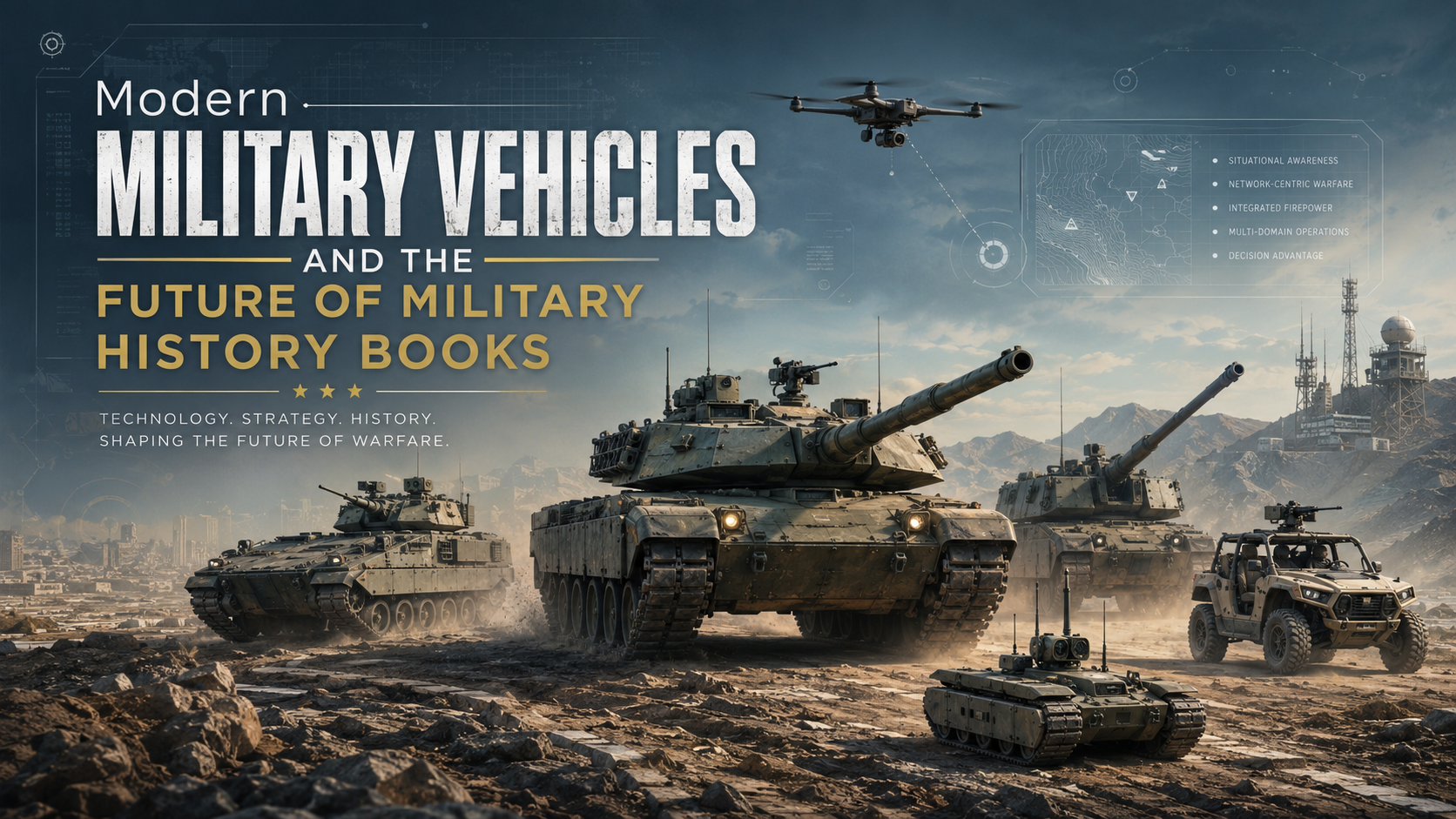
Modern Armor gives readers a wide-angle look at the vehicles likely to shape the next major land war. The book includes Main Battle Tanks, Infantry Fighting Vehicles, self-propelled artillery, light utility vehicles, air defense vehicles, communications platforms, electronic warfare systems, and Robotic Combat Vehicles.
This approach matters because no single vehicle wins a modern battle by itself. Tanks need scouts. Infantry needs protected mobility. Artillery needs targeting data. Air defense vehicles must protect the force from drones and missiles. Command vehicles must keep units connected. Robotic Combat Vehicles may soon take on dangerous missions that reduce risk to human crews.
For readers who want to understand how these systems work together, Modern Armor offers more than a list of machines. It shows how modern armies are organized, equipped, and challenged by real battlefield conditions.
Why Modern Armor Belongs Among Military History Books
Many people think military history books are only about past wars. But serious military history also explains how today’s forces were shaped by previous conflicts. The lessons of World War II, the Cold War, Iraq, Afghanistan, Ukraine, and Gaza continue to influence vehicle design and battlefield tactics.
Modern armor exists because past wars exposed specific problems. Mine-resistant vehicles came from the need to protect crews from roadside bombs. Active protection systems became more urgent as anti-tank missiles improved. Air defense vehicles returned to center stage as drones became cheap, common, and deadly. Digital communications became essential because commanders now need real-time awareness across wide battle spaces.
In that sense, Modern Armor belongs naturally among meaningful books on military history. It does not only describe what vehicles look like. It helps readers understand why they exist, what threats shaped them, and how military technology continues to evolve.
Books on Military History Should Also Explain the Human Side
The best books on military history do not treat machines as if they operate themselves. Behind every armored vehicle are drivers, mechanics, operators, gunners, artillery crews, technicians, commanders, and support teams.
Mike Wangler’s book recognizes that modern armor is still a human story. Crews must make decisions under pressure. Mechanics must keep complex systems running in harsh conditions. Operators must understand sensors, radios, weapons, and threats. Commanders must decide when to move, when to hold, and how to protect their people.
That human side is one of the reasons military vehicles remain so compelling. A vehicle may be built from steel, electronics, and weapons, but its value depends on the people trained to use it. Technology matters, but courage, discipline, maintenance, teamwork, and judgment still matter just as much.
Why Mike Wangler Brings Real Experience to the Subject
Mike Wangler brings credibility to this subject through both military and technical experience. He is a graduate of the U.S. Naval Academy and served on active duty in the U.S. Marines in communications, signals intelligence, and electronic warfare fields. In his civilian career, he worked on national, U.S. Air Force, and U.S. Army advanced technology projects.
That background gives Modern Armor a practical point of view. Wangler understands that modern vehicles are not just mechanical platforms. They are part of a larger system involving communications, sensors, electronic warfare, command networks, and technology integration.
This makes the book useful for readers who want more than surface-level descriptions. It speaks to the technical side of modern warfare while still remaining accessible to readers who are exploring military vehicles, military history, or defense technology for the first time.
Who Should Read Modern Armor
Modern Armor is a strong fit for readers interested in military vehicles, modern warfare, defense technology, battlefield strategy, land combat systems, and the future of armored forces.
It is also useful for readers who enjoy modeling, gaming, military research, or visual reference books. Anyone who wants to understand the difference between a Main Battle Tank, an Infantry Fighting Vehicle, a self-propelled artillery system, or a Robotic Combat Vehicle will find value in the book’s wide coverage.
For readers searching for military history books, the book offers a modern angle. It helps connect past battlefield lessons to today’s vehicle development and tomorrow’s combat risks.
Final Thoughts on Modern Military Vehicles
Modern warfare is changing quickly, but land vehicles remain at the center of military power. The future battlefield will not be shaped by tanks alone. It will be shaped by networks of armored vehicles, artillery systems, drones, air defense platforms, electronic warfare tools, robotic systems, and the trained people who operate them.
Anyone searching for military vehicles, a new military vehicle, or meaningful books on military history will find Modern Armor a timely and detailed guide. Mike Wangler gives readers a clear look at the machines shaping the future battlefield while reminding us that modern armor is never just about metal. It is about technology, strategy, survival, and the people who carry the fight forward.